
What the mill paid, what the sawmill pays
A 1983 payslip in constant euros, a 2026 sawmill pay scale. The comparison vindicates neither those who mourn the mill nor those who celebrate the reinvention. It gives figures.
Théo Brissac5 min read
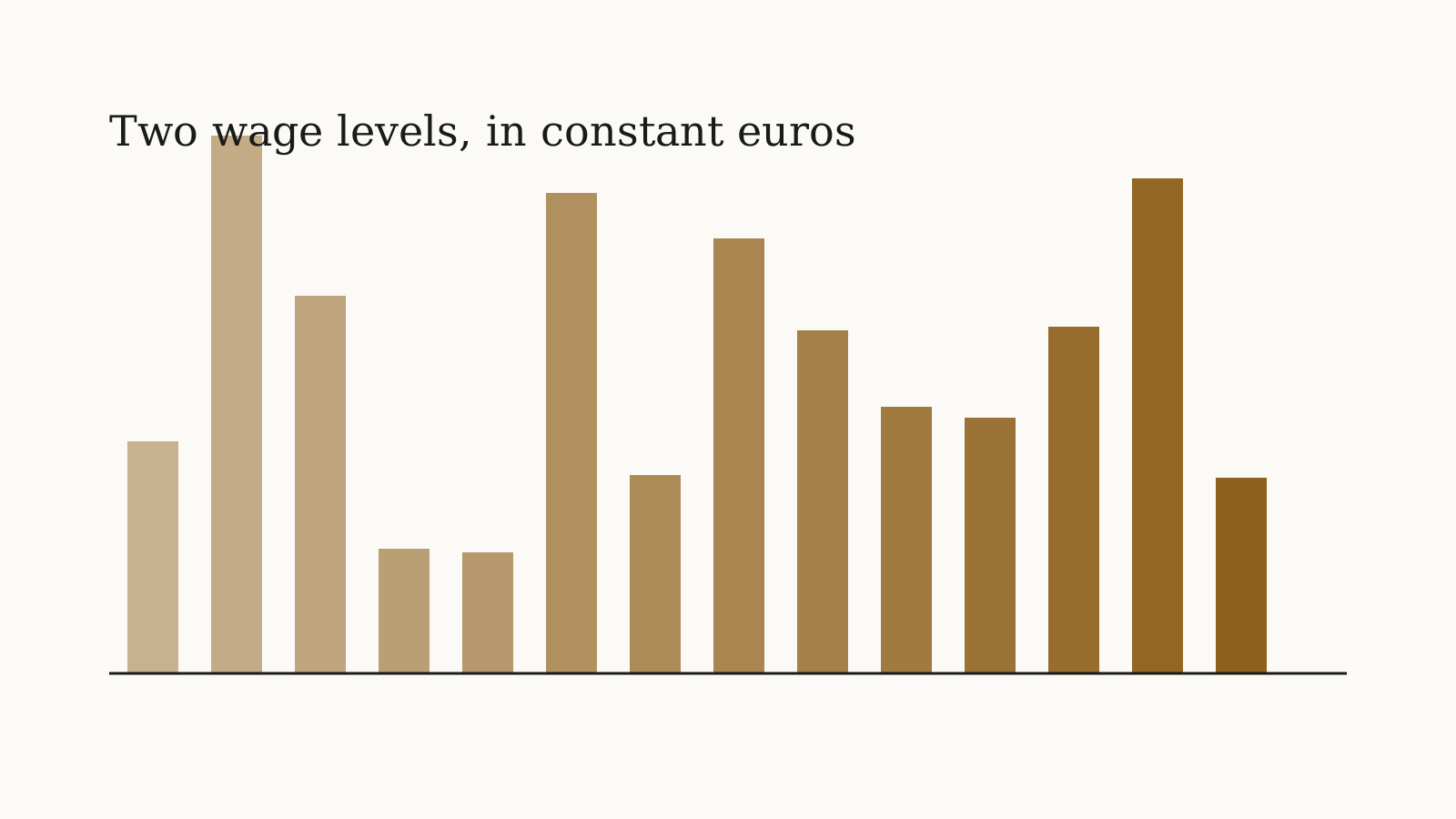
Two accounts have circulated on the plateau for forty years, and they do not speak to each other. The first says the mill paid badly, that its closure hurt but the area recovered through forestry. The second says 214 industrial jobs were replaced by 34, and the rest is a figure of speech.
Both are checkable. This third instalment does not arbitrate between them: it puts them in front of the same figures, and lets you see where each is wrong.
214staff
at the mill on its last day, 168 of them women
34staff
at the Vaubernier sawmill in 2026
1,776€
the 1983 entry wage, brought back to 2026 euros
2,070€
the sawmill's 2026 hiring scale
14months
that 2 sawyer posts have gone unfilled
The method, before the results
A 1983 wage cannot be compared to a 2026 wage by looking at it. It has to be brought back to constant euros — correcting for forty-three years of cumulative inflation — and set against a like-for-like base: gross pay excluding bonuses, full time, at equivalent skill.
That last point is the delicate one. A winding-room worker at the mill and a head sawyer in 2026 do not do the same job, and one of the two requires a qualification the other did not.
The starting document is a payslip from June 1983, kept by a former winder and passed to this newsroom: 3,640 francs gross for 169 hours, excluding bonuses. Converted at the statutory rate, that is 555 euros of the day; the price index having been multiplied by 3.2 since, the wage is worth 1,776 euros of 2026.
What the sum gives
In constant euros, the 2026 entry scale is higher than the 1983 one. The gap is not spectacular, but it is clear, and it points the way the first account claims: 2,070 euros against 1,776, that is 294 euros and 16.6 % more, and 2,290 euros after three years of service.
The second account is right about something else: the number. Where the mill supported 214 households, the sawmill supports 34, and two of its posts have been vacant for fourteen months for want of qualified applicants on the plateau. A higher wage, paid out six times less often.
And paid out less often than it might be: those two posts want for applicants not because the sawmill pays badly by 2026 standards, but because it pays 380 euros a month net less than the valley employers recruiting the same qualification. The 1983 wage faced no such competitor: the two firms in question opened, one in 1997, the other in 2011.
The payroll mass gives the measure of it. At 1983 levels brought back to 2026 euros, the mill paid out in the order of 4.75 million euros gross a year to plateau residents. The sawmill pays out 890,000. The gap, 3.9 million euros a year, is roughly 16 % of the Hauts authority's annual budget — not because the authority collected it, but because that is the order of magnitude that left the local economy, and it compares badly with any line of grant funding.
One last point turns the first account around, and it should be put just as plainly. The 1,776 euros are an entry wage with no qualification; the mill had others. A loom fitter, in 1983, was paid 4,480 francs, that is 2,186 euros of 2026 — above the hiring scale of a head sawyer, which is today the most qualified production post at Vaubernier. At comparable skill, forty-three years have changed almost nothing: it takes three years of service at the sawmill to get back in front.
What neither account says
The 168 women. The mill mostly employed women; the sawmill employs three women out of thirty-four. The replacement people have been discussing for forty years did not only change in volume and in pay: it changed population, and neither version says so.
That is the single point on which this series will take a side: it is not a sociological footnote. It is the best-documented fact in either comparison, and the least quoted.
There is a second one, less visible, and it bears on the future rather than the past. The thirty-four jobs of 2026 rest on an exceptional volume of timber: the 300 hectares of spruce lost to bark beetle in the Sylve-Noire, taken out in five years from the 2,900 the massif holds. That is a stock being liquidated, not a resource being renewed — and the replanting that follows will not yield a saw log for several decades. The mill, for its part, ran for a hundred and eleven years on a material that arrived by train.
Comparing two wages is an honest exercise. Comparing two jobs means also saying how long each was meant to last, and on that ground neither account has ever offered anything.