
She took over the Sagnes farm alone, with no cattle in the family
No farm in the family, no land, no herd: in 2021 she took on the 42 cows of Les Sagnes with a financial structure nobody in the valley had tried. Five years on, the structure is holding. Only just.
Camille Fournier-Braud5 min read
Setting up outside the family line, in the mountains, with a dairy herd: on the plateau that had happened twice in twenty years, and both times it had stopped before the fifth year. That is the figure she was given in 2020, when she started putting the file together.
She took over in 2021. The 42 cows are still there. What follows is not the story of that success: it is the detail of the financial structure, because the structure is what decided it, and because it could have failed on three precise points.
What had to be bought, and what absolutely did not
Taking over a farm means taking over three separate things: the land, the buildings and the herd. The classic mistake, she says, is to want all three at once, because that is what the seller offers.
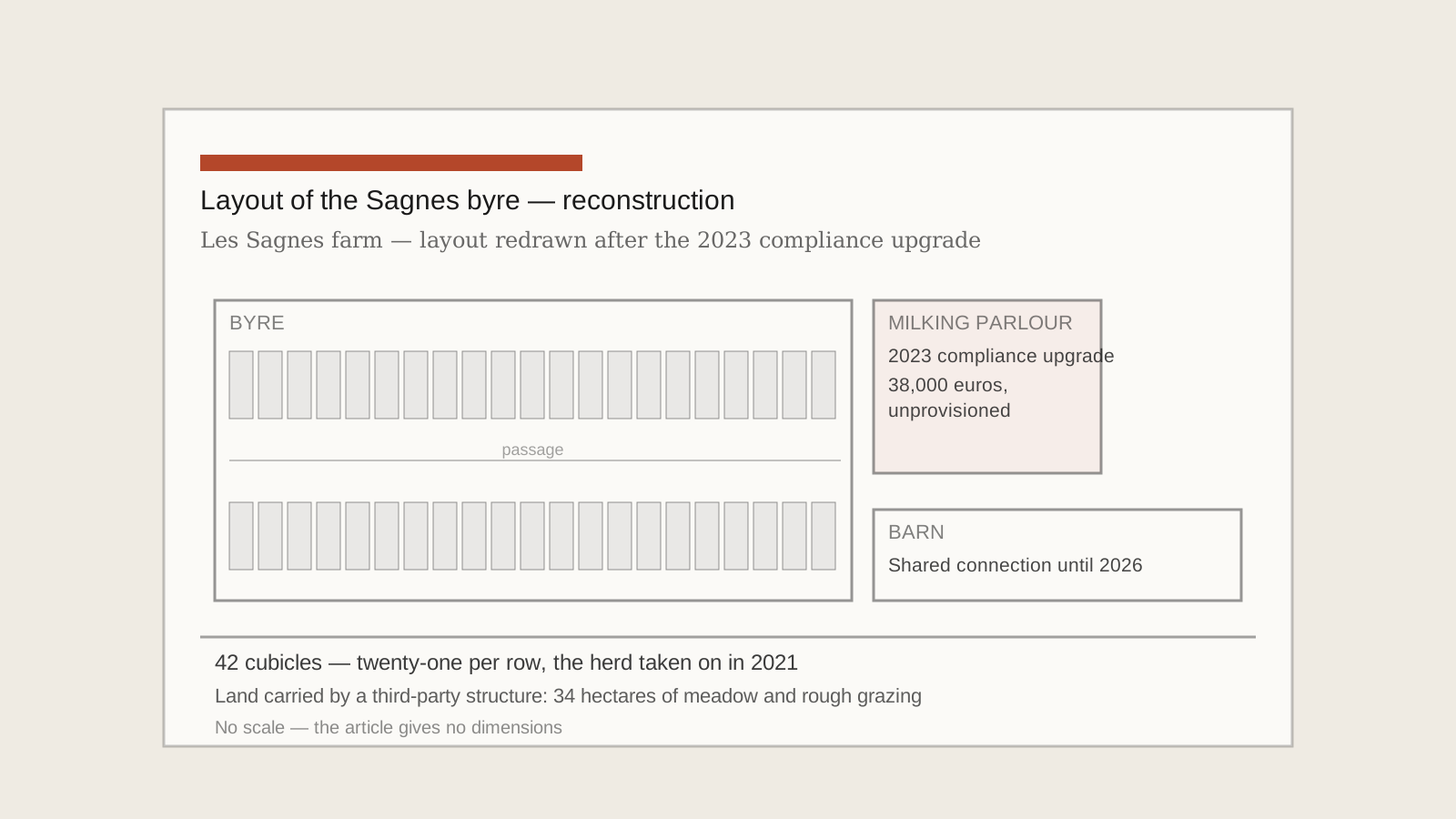
The initial offer fitted on one page and came to 512,000 euros: 238,000 for 34 hectares of meadow and rough grazing, 162,000 for the buildings — byre, milking parlour, barn — and 112,000 for the 42 milkers and their followers. At current rates and terms, that sum would have repaid at an annuity of around 34,000 euros. The farm's gross margin, as the seller himself presented it, was 61,000 euros.
She bought only the herd. The land went through a carrying arrangement — a third-party structure buys it and leases it back, with a buy-out option at nine years. The buildings were leased from the seller on a long tenancy. Opening debt therefore fell to 112,000 euros over twelve years: 11,400 euros of annuity instead of 34,000. Against that, two new rents, 7,300 euros for the carried land and 5,800 for the buildings, or 13,100 euros a year.
The arithmetic of the takeover sits in that comparison. The structure did not make the operation cheaper — 24,500 euros of annual charges against 34,000, a gap of only 9,500 euros. It changed the nature of the charge: a rent can be renegotiated, suspended, handed on; an annuity cannot be argued with, and a bank does not lend twice.
I was told that carried land is not ownership, so not a real setup. I did not answer. What I mainly wanted was to still be here in 2026.
Five years of tight cash, and what ate them
The plan allowed for five tight years, with the low point in the third. The low point came in the second, for a reason that appeared in no forecast: a compliance upgrade to the milking parlour, ordered after an inspection, 38,000 euros unprovisioned.
That is where the structure earned its keep, and the 9,500-euro annual gap is enough to show it. Over the first two years it had left 19,000 euros of cash inside the farm; the carrying body agreed to suspend two rent instalments, which no lender would have done on an annuity, and the balance was spread over three years. Under the initial offer, the same expense would have met a self-financing capacity of 27,000 euros and an annuity of 34,000: it did not fit.
Two other items weighed, less dramatic and more lasting. Bought-in feed, first, which doubled between 2021 and 2023 before settling 40 % above the forecast assumption. Then broadband, which only reached Les Sagnes in April 2026: for five years every online declaration, every milk-recording return and every feed order went through a phone hotspot, from the one spot in the barn where it gets a signal.
What would have sunk it
Three points, which she lists without hesitating because she listed them at the time. A seller in a hurry to sell the land rather than let it be carried. A bank demanding a personal guarantee on the whole amount. And the absence of organic conversion, which pushed the milk price above the viability threshold in year four.
That last point deserves its figure, because it is the only one of the three that replays every year. Conversion, begun in 2021 and certified in 2023, is worth in the order of 90 euros more per thousand litres. On the 195,000 litres delivered in 2025, that comes to 17,500 euros — almost exactly what the two rents cost, land and buildings together, less two months. Without it the structure would break even instead of leaving a margin.
Two of those three were outside her control.
Five years on, the land buy-out option falls due in 2030. It covers the 34 hectares at the indexed purchase price, in the order of 265,000 euros, of which a fifth has to be found up front. Fifty-three thousand euros to gather over four financial years: that is the next deadline, and she does not yet know how she will meet it. She says so without drama: it is a deadline, not a threat, and she wrote it into her plan on day one.
Not taking up the option would not be a failure either. The lease continues at a revised rent, and the farm runs on. What she loses then is the one thing she has never had: the guarantee of staying.
This file was not sturdier than any other. It was more honest about what could go wrong.